
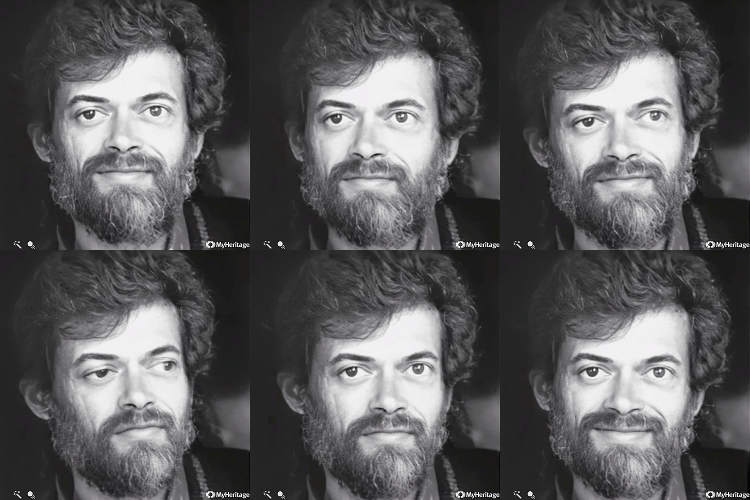
McKenna

It first was noticed in 1853 by the British botanist Richard Spruce, who was making collections on a river in Brazil, and he observed the people making some kind of an intoxicant out of this vine. And then a couple of years later, a thousand miles away in a different part of the scene, he saw the same thing going on. And he noticed that this was a vine in the Malpighiaceae. This is the family. Plants are divided (as animals are divided) into families, genuses, and species. And the Malpighiaceae is this large family of tropical climbers. And not a whole lot was done with it. In the early 1900s, German ethnographers like Theodor Koch-Grünberg wrote about it and may have brought some samples back to Germany. But it really wasn’t until the 1930s that anybody looked at this.
Well, when you start looking, it’s very interesting. It’s a—there are all kinds of interesting things about it. It’s a combinatorial drug. It’s not like peyote or mushrooms or datura, where one plant contains the full spectrum of the alkaloids necessary for the activity. It’s a situation where two plants have to be brought together and combined in a certain ratio. And the way it’s made, and the plants that it’s made of, vary over a large area in the Amazon, according to what plants are locally available. Also, the methods of preparation vary. So, sometimes it’s what’s called a cold-water infusion. That means that the smashed stalks of vine and the extractive chemistry works. The more gentle the extraction, the more complex the materials that will come out. So in a plant like Banisteriopsis caapi, you have at least three things that are potentially active: harmine, harmaline, and tetrahydroharmine.
The general rule of thumb is: the more complex the molecule, the easier it is on your system. So if you do a cold-water infusion of Banisteriopsis caapi, what you get is the harmaline and the tetrahydroharmine. It tends to leave the harmine behind. But it also tends to be, because of this, less effective. All three of these compounds are monoamine-oxidase inhibitors. That means that all three of them will contribute to synergizing DMT, which is present in the brew from the additional admixture. And the whole technology of ayahuasca is a technology of bringing these two plants together in correct ratios so that you strongly synergize visions, but not so strongly accentuate the unpleasant side effects of harmine—which are, well, basically vomiting an intense gastric rejection of it. This happens anyway. It’s very purgative.
So what evolved in Peru—and we have no notion of how long it’s been going on. It’s very hard to get archaeological evidence of drug use because it’s such a subtle cultural phenomenon. Unless you actually find the ancient drugs, as in the case of some of the snuffs that have been found in the deserts of southern Chile recently, you’re going to have to work from conjecture, mythology, possible vase paintings, and stuff like that, or paraphernalia. The paraphernalia of the snuff cult makes it identifiable when you come upon it, but the paraphernalia of the ayahuasca cult is simply the same paraphernalia people use to cook and prepare food in the jungle. I mean, it’s fires and pots and smashers and choppers.
Anyway, for a very long time this has been going on in South America, and it’s still really to be studied. It’s been kind of ignored. It’s slightly surprising how ignored it’s been, because it represents such a major psychedelic religion. I mean, probably millions of people—possibly millions of people, I would think—are involved in this right now. And it’s hard to say whether it’s growing or shrinking. Peru, which is one of the four or five countries where this is going on in a major way, is in a lot of turmoil. On the other hand, turmoil has characterized most of its history. Ayahuasca is a phenomenon of the country people; of the campesinos and the mestizos. And it’s undergoing change in different directions.
You know, there’s a lot of syncretic religious foment in Brazil—elements of Santería, and Caribbean religions, and Catholicism, and psychic healing, and European occultism is all in ferment there. And so is the ayahuasca, which in Brazil is called daime, has in the last fifty or sixty years been appropriated by these quasi-religious groups. There are two major groups in Brazil involved in this. One is called the União do Vegetal, and it seems to be on the lower river, meaning below Manaus, which means in the large cities. And they are brewing a weakened form of ayahuasca, which they call—I think they call it huasca. And then, further up the river, the Santo Daime people, who are a little more distinctive, but not to my mind terribly attractive. They wear uniforms and practice paramilitary maneuvers and have some peculiar theology of cultural revitalization based on the use of daime. I know those people have been coming to Argentina and Los Angeles recently and beginning circles, so I think there is some sense in the native ayahuasca movements that perhaps the time has come to try and export this out of the cultures where it first came into existence and into modern life.
As for what it is, it’s very interesting. It is extraordinarily restorative. It is a purgative. What we know medically about it is that it is a strong purgative, that it kills intestinal parasites, and that it has possibly an adverse effect on the trypanosomal stage of the malaria organism. They did experiments at the University of California Medical Center in San Francisco where they were able to kill trypanosomes on petri plates with small amounts of dilute ayahuasca. Well, if this were to stand up over time, you would see that this had, then, a very strong impact on people’s cultural adaptive response to malaria in the Amazon. You would almost have to say that people who didn’t take this stuff were at serious risk to be in these places because malaria is so all-pervasive.
And a system of curing has grown up around this; a whole medical system that is now in great danger of being lost or forgotten or quack-ized in some way. Because people are getting into it, but they know very little about it. In the traditional situation, a long apprenticeship was required to be able to give this stuff to people and to be able to take it—and a diet. And what’s interesting, I mean, there are many, many things that we could say about it that set it apart and make it interesting. It’s running on, as I said, harmine and on dimethyltryptamine, DMT, to accentuate the visions. Well, these two compounds are both endogenous hallucinogens. That means both of these compounds occur in the human body under ordinary circumstances in the human brain. So, in a way, what we have with ayahuasca is not a kind of folk pharmaceutical intervention in illness or neurosis, but actually a brain cocktail: a shifting of ratios and accentuating and saturating with compounds already a part of normal metabolism.
Well, in spite of the fact that these things are constituents of normal metabolism, the way this presents itself is as a profound visionary experience. So that—and it’s fairly brief. It lasts about four hours, and then there’s a long gliding integration. And there is never a particular energy loss. In a way, you seem to have taken one small step which you are not asked to retract. There is no energy death. This is very interesting, and is a hint that the right strategy with these shamanic hallucinogens is this effort to see them as intervention into ordinary brain chemistry that is shifting ratios but not adding new factors into the mix. And I don’t know how many of you have been here for all of these lectures, but in many of the lectures we’ve touched on the unique ability of ayahuasca to promote synergy, synesthesias, situations where music is beheld, specifically the self-generated music of these tribal groups: that these songs that are being sung are to be appreciated pictorially. They are sculptural constructs in an idiom of sound that is intended to be beheld. And this is something that we have no cultural lock on. We have nothing comparable to this.
When the people like Koch-Grünberg and the early people into the Amazon began naming the suspected active agent in ayahuasca, they called it telepathine. Because they believed that group states of mind were being generated in these tribal groups. And, in fact, this is not that far off the mark. I mean, a kind of pedestrian notion of telepathy is: I think; you hear what I think. But notice that even though thinking is not an audio function, the cultural assumption is that thought would be heard. There’s no reason for this. I mean, thought could be felt or it could be seen. And this, in fact, appears to be what is happening.
DMT—this domain of compounds that I’m interested in, that I keep restricting our attention to, these indole tryptamine hallucinogens—it’s because they are so much like brain chemistry and they act so directly on the language-forming centers. DMT can trigger spontaneous glossolalia. The shift in neural processing that takes place in the presence of ayahuasca causes songs to be beheld. What we’re moving here in is the realm of signal processing, perception, and language generation. This is where these things are particularly targeting and in different ways. For instance, I talked about how the mushroom speaks. Psilocybin, 5-Hydroxy-N,N-dimethyltryptamine—again, just a gnat’s eyelash away from these other compounds. It speaks. Another causes music to be visible, so forth and so on. Another triggers glossolalia.
So, for me, what is interesting about the ayahuasca phenomenon is the idea that what is happening here is a kind of recreation in the new world of this symbiosis with a plant that I suspect lay behind our prehistoric condition. That, in the past, before history, during the melting of the last glaciers and before—15,000 to 25,000 or more years ago—a whole different kind of mental life was available to human beings. And it was not a diminished or brutish mental life. It was a tremendously rich, integrated kind of mental existence that lay beyond the contradictions of dualism and class structure and division of labor and all of these things that we associate with our fall into history. And it would be tremendously illuminating to this idea, this idea of a symbiosis in prehistory, to then be able to study a living example of this.
And the obvious place to look is the Amazon. There is a density of preliterate people that exceeds that of preliterate people anywhere else in the world, and a density of hallucinogenic plants. Well, when you look there, you find a set of social mores which, while not exactly mappable over the situation of saccharine pastoralism that I’ve talked to you about as being a precondition for the emergence of consciousness, nevertheless, you do find human groups using plants to create boundary-dissolution and group states of mind where cultural decisions—decisions about migration, and hunting, and how many children the tribe wants to see in the coming year, and this kind of thing—is all routinely decided.
Well, because this vegetable matrix—this integrated system of chemical relationships that is represented by plants—is really the regulator and governor of the ecology of the planet, we have to come to terms with it. And we know that now, because we’re getting readings off our instruments that tell us that we are headed into all kinds of synthetic fluctuations created by industrial processes. This symbiosis with the plants is not an airy-fairy notion. It’s absolutely central to an intelligent species to have a symbiotic relationship with the matrix of life on its planet. Otherwise, the intelligent species will quickly elaborate a set of lethal cultural adaptations which will have negative feedback into the planetary life system—precisely the situation in which we find ourselves. Intelligence on the surface of a planet must be mediated by a symbiotic relationship with the rest of the living world, because intelligence is capable of setting itself against the grain of the living world in the way that we have done, and then this has all of the unforeseen consequences that are now coming to bear on our heads.
So I think it’s worthwhile to take seriously that something unusual is going on with ayahuasca in the Amazon. This is not simply another native shamanic use of a plant, and that we can send down some ethnographers and anthropologists and understand it, but in fact this may be the last existing remnant of real partnership society, where partnership means not something as trivial as overcoming gender polarities, but as overcoming the plant-animal polarity, and creating a civilization that’s plugged directly into a sense of bios.
Yeah?
Audience

[???]
McKenna
A coarse question, since symbiosis by definition is a situation where mutual benefit is derived from cooperation. So it’s not parasitism, where one organism actually draws energy from another and lowers the adaptive capability of that organism. It’s mutual benefit. In the case of ayahuasca, this is a tough question. Because the Banisteriopsis liana is perfectly capable of supporting itself as a wild plant in the jungle. In the case of the hypothesized human–mushroom relationship at the beginning of prehistory, it’s pretty clear there that what the mushroom gained out of it was, first of all, the domestication of cattle and the inculcation in the human culture of this habit of yearly burning meant that pastoralism essentially could be seen as a project to expand mushroom ecologies for these coprophitic, dung-loving mushrooms. So cultivation is always a game that accrues to a plant that cuts a deal with human beings. We will expand its range. We will water it, clear for it, and bring it into ever-greater distribution.
The gain for the Amazonian plants is not really clear. The symbiosis in that case is not so much that human populations, by taking ayahuasca, are doing something for the ayahuasca vine. It’s that, by taking ayahuasca, they are being shown a lifestyle which is in equilibrium with the rainforest. That’s the more important point there: that the entire life force of the Amazon is gaining by the kind of lifestyle that the people who use these things choose to practice. In other words, they practice swidden agriculture on a very low-impact level. That means they cut and burn very small fields, less than an acre. These things can be closed in and reclimaxed in a couple of hundred years. And their numbers are low, and the entire lifestyle is non-invasive. Because you cannot invade the Amazon unless you have massive amounts of technology and capital behind you. You have to come to terms with it. It’s almost a miracle that there are people there at all.
I don’t know how many of you have been to the Amazon, but people have a great misconception. They believe that vegetable lushness must signify a protein-rich environment. That, surely, in these thousands and thousands of tons of plants, it must be an easy life. There must be lots of food and fruit and meat. Well, what’s actually going on is the Amazon is an alluvial plain from the Andes that has been washed down. It’s basically quartz sand. And where it isn’t quartz sand, it’s laterite. And this unbelievable climaxed jungle that covers every inch of it, it’s taken it 220 million years of continuous evolution to get this trick down. And the way the trick is done is: every bit of biologically usable material is in a living system. I mean, they estimate that 95% of all organic material in the Amazon at any one moment is in a living system. That means that when a leaf falls, within fractions of a minute, the first ant will arrive and begin taking it apart. And everything is moving back into circulation. In an evolutionary situation like that, there is tremendous competition for protein. And protein cannot then be concentrated in nuts and luscious fruits and root crops, because protein must be kept circulating. So consequently, it’s very thin in the Amazon. And there is no way to support a large population before the advent of imported food—rice and flour and this sort of thing. And these tribes of people rarely numbered more than seventy or eighty. When they got to be larger than that, there was some kind of syzygy and they would separate. So—
[Video cut]
—that is primarily psychedelic, primarily springs from intuition.
Yeah?
Audience
How did they ever figure out to put these two plants together? Because one doesn’t work without the other one, so how did they figure that out with thousands of plants down there? I can imagine it just… a message from somewhere to do that or try to just….
McKenna
Well, this is one of those little facts that intrudes into the rational scientific world that it can’t do anything about. How did they figure this out? Considering that these people didn’t have a lot of leisure time, and there are hundreds of thousands of species of plants, and that the two prime ingredients of ayahuasca are a lot of this vine. And when you actually show someone how much of the vine goes into a single dose, they’re amazed. Because they think of these plants as powerful and fragile. And actually, you’re involved in almost a semi-industrial extraction in order to concentrate it sufficiently. It’s spread very thin, the pharmacologically active agent. And then, in the DMT-containing plant, it doesn’t grow precisely where the ayahuasca grows. If ever a plant looked like any other plant, this is the plant. I mean, it is literally the most nondescript bush you have ever seen. And so they are taking huge amounts of one, the woody part, discarding the leaves and the fresh growth, and then in the other one concentrating on gathering the leaves and the fresh growth, bringing them together, and then you have to boil it in huge amounts of water for hours and hours, and then pour off the water and save it. And it’s not easy in the Amazon to get together a tub. The simplest things become unbelievable logistical problems. So you have to pour off the mother liquor from the first boil and save it in something, boil the whole thing again. So you’re keeping fires going; quite vigorous boiling fires for many hours in an environment where it can approach 100% humidity. And then you recombine these two large amounts—many, many gallons of water—and then you carefully boil it down without over-boiling it and caramelizing it, until you have for—well, a typical ayahuasca group would be maybe fifteen people. So for fifteen people that would be like at least thirty kilos of ayahuasca, which is a costal, a gunny sack full, and a huge plastic bag full of the chakruna leaves. You have boiled this, you’ve rendered it, you’ve concentrated it, and finally you get it down to this stuff which you can’t imagine anybody willingly taking more than a taste of. And yet, you have to chug down twice that much.
So I’m telling you this story to point out to you the number of unlikely points along the way where there could have been a decision to do it differently, and you would have missed the point entirely. So how do they know this? Well, they say that the spirits tell them. The only anthropological evidence along these lines was a famous anecdote. A graduate student of Schultes, named Melvin Bristol—who studied daturas; these arborescent daturas that I’ve talked to you about in the valley of the Sibundoy—and he took ayahuasca with a Sibundoy shaman, and in the midst of the visions, the visions showed him a plant. And the voiceover or the informing lógos of the visions said, “This is a magical plant.” And he was a botanist, and he had never seen this plant. So then, after the trip was over and he came down, he told this shaman about this. And the guy said he didn’t know, that it was nothing he knew, but that he knew what he was talking about, that he knew the plant. And the botanist thought he did too; that he could identify it to family. So then, a few days later, walking in the mountains, they came upon a plant that they agreed they thought was the plant. And when it was taken back to Harvard it was in fact alkaloid positive and psychoactive in human beings.
Well, to me what this implies is that we are naïve about the depths of nature, and of what the real nature of communication is. And we give a lot of lip service to that the mountains speak, but do they tell you how to balance your checkbook? And the answer may be in some sense: yes. That they can speak in any language you are prepared to understand. Otherwise, I don’t see how you account not only for the remarkable discovery of ayahuasca, but for instance curare. Curare is a horrifically toxic arrow poison. A gram of it in the United States sells for several thousand dollars, because it is used in brain surgery to anesthetize single nerves. And they not only discovered that there were certain plants with this in it, but they discovered how to concentrate it in a situation where nobody has gas masks, rubber gloves, metal tongs, anything like that. They will troop out into the woods and prepare curare, and go from the raw plant, render it down in these pots where, if you stand downwind from this you are just dead meat, and then bring it back and sell it to traders. So they have learned their way into the mysteries of nature.
Of course, I’m sure these Amazonian Indians must sit around the campfire at night and say, “You know, there was an anthropologist here, and he explained to us about the charm quark. How do you suppose these white people ever figured out something like the existence of the charm quark?” I mean, after all, you have to sort of know it’s there, because you have to build a machine that costs 50 million dollars to even correctly search for the thing. So what it means is—is it the Bible that says understanding passeth everywhere? Anyway, somebody said it, and it’s true. Mind falls into the interstices. Mind finds ways. Mind is into the Tao of how.
Audience
[???]
McKenna
The Other. The location of the Other, and whether it is coming through the plant. See, symbiosis is a kind of a cold and biological word to apply to this relationship. Because it is an inter-species relationship, so it is technically symbiosis, but it is also, emotionally, it’s like love. It’s like a relationship. It’s that there is something there that touches your heart. And what I said in the introduction to The Mushroom Grower’s Guide, what the mushroom said to me when I said, “What do we bring you? What is it for you?” they said, “You have hands. We have no hands. We have a dream. But we are like cobwebs in your world. We cannot move so much as a pebble. We are almost of the essence of pure thought. You can bring the fire of the stars to the surface of the Earth. You smelt metal. You weave cloth. You wield ink and paint on stone.” So it was like saying: what we want to do is create in matter. And the symbiotic trade-off is that we would then come into alignment with this, and they would guide us.
And to some degree I think that’s what human history is, except it’s been unconscious. But the mentor now seeks to be recognized and is saying, “Your childhood is ending. You need to recognize the responsibilities of maturity, and that means you need to recognize the situation. And the situation is not that you are as you imagine yourselves to be.”
The communication thing—they are intense. All of these states where you are in presence of the Other, there is an intense transfer of information back and forth. I don’t know if you were here the other day, but when I said that, in thinking about the tykes—the creatures seen in the DMT thing—that it seemed to me that they were meme traders, and that therefore it was wrong to go into that ecstasy with a question. They want you to bring an answer. They collect answers. They’ll trade you one of their answers for one of your answers. And not that they will take your answer seriously any more than that I would buy an Amazonian mask in order to wear it in ritual dances. It’s more a collector mentality, and it’s a desire to communicate.
I mean, our longing for the Other may be not a quality of our monkeyness but a quality of our own intelligence. In other words, the Other may be characterized by longing for the Other; that we seek this self-reflection. This is why, in the twentieth century, the image of the alien is so strong, you know. Because we have transcended all other believable gods. We’ve chased them down and turned them into museum dioramas. But even our science still holds open a small possibility of truly awesome forces coming to us from this one dimension that is still held a possible domain of the Other.
And then the other domain of the Other—which is not held as possible; which is illegitimate, of course—is the hallucinogens. Maybe the fascination with shamanism signals a turning point in that, and we are going to see eventually hallucinogens taken seriously as an avenue for the Other. The fact that Carl Sagan would come to see me in Hawaiʻi just to make sure, just to satisfy himself, that it was in fact preposterous and outlandish indicates on what unsettled and shifting ground these people operate. We shouldn’t be cowed by science. I mean, look at this cold fusion episode. Whatever else it proved, it proved that they don’t know what’s possible. I mean, it took them weeks and weeks to sort this thing out, and they even had mechanisms by which it could be so, and they said, “Well, now we believe that it could be so because certain exotic this-and-that reactions, which are ordinarily not seen, might account for the ratio of isotopes that are being measured.”
So what it means is: when you put pressure on them, they don’t know. They’ll scramble every which way, because they want to get the lid back on and say, “Well, it is astonishing, but not paradigm-shattering. It is progress within the paradigm, but it does not do damage to the epistemic machinery itself.” But whether or not this fiction can be maintained, I don’t know.
[Video cut]
—that mushrooms were in fact an engineered artifact of an alien civilization, and that they were spread here with the purpose of communicating. You see, I don’t have quite the joy in this that I used to. I don’t know why. But you can make a very strong case that makes it seem very credible, from my point of view, that the mushroom could well be an extraterrestrial. You want me to do it?
Audience
If the spores were brought here by—
McKenna
No, not even that the spores were brought here. If you want to look into this, there’s a book called Strategies for Extraterrestrial Communication by Bracewell. They talk about in there—what they try to do is: they try to create an algebra of strategy for extraterrestrial communication that would work for any extraterrestrial. So, see, this is a kind of an effort to deprogram yourself and say, “Well, let’s just look at the problem on the largest possible scale and see if we can’t conceive of a generalized strategy.” Okay, well, what are the facts on the table? The facts on the table are: the universe is huge. Huge! The distances are vast. The stars are spread very thinly. Stars of any given type are spread even more thin. So it’s hard to imagine a civilization for whom the economies of energy would mean nothing—in other words, for whom it would be as easy to visit a billion stars as one. I mean, that just… I mean, that’s—we’re not talking civilizations, we’re drawing God Almighty. We have to imagine that certain kinds of logical constraints can be supposed to be in place.
Well, so Bracewell said: well, how about this strategy? The communicating planet sends out four probes. At a certain distance from the communicator—and let’s give this communicating planet as advanced a technology as we can imagine. In other words, there are no technological limits on this civilization, except that it cannot violate any known natural laws. That’s a big except, because we’re saying that it cannot exceed the speed of light. So therefore, if it’s operating under the constraints of the speed of light, the universe is truly formidable as an object to explore. Nevertheless, the communicating planet sends out a probe, or four probes in four opposed directions. At a certain distance from the planet, the probe is technologically sophisticated enough to replicate itself. At another preset distance, each probe replicates again. The notion here is that, as the sphere of these things expands around the home planet, the number of them increases so that the average spatial density of them stays the same.
Well, if this process can go on virtually indefinitely, then you would eventually have a shitload of these probes, you know? But there are problems there. I mean, where is the raw material that these things are constructed out of? Well, obviously, the smaller you can make them, the less raw material you will need. So there is tremendous pressure on microminiaturization of this probe.
Well, when you look at microminiaturization, the kinds we know about that perform complex tasks are cellular machinery. So let’s assume that this civilization can build machines at the cellular level. Well, then, what you would build is a gene packet of some sort; a generalized gene packet linked to a message unit, encased in an extremely impenetrable and highly radiation-resistant outer shell.
Then you would—well, then there are other tricks. For instance, it would be nice to propel this thing some way. You could get the job done with what’s called Brownian motion, which is simply randomized drift of particles. They would percolate through the galaxy from a given source over about 300,000 years. Well, actually, in terms of processes on the astrophysical level, that’s pretty rapid. That, without any propulsion system at all, these small probes would percolate out through a volume the size of the galaxy within 300,000 years. Now, if you could give them some kind of propellant system, any kind of directional ability to move, you can chop these numbers down pretty dramatically.
Well, so then, laying aside all these theoretical considerations, then you say: well, is there anything in nature like that? And then you look at the spore of a psilocybin mushroom like Stropharia cubensis. The first thing you learn when you get into spores is that they’re made out of this really unusual material. It is the hardest organic material known. It is not only hard, it is electron dense. This means that, electrically and chemically, it is more akin to a metal than anything else. It is a super electron dense organic chelate.
Well, then you look, for instance, at the color of the mushroom spore. It is deep purple. This is exactly the color that you would paint a spacecraft if you wanted it to reflect radiation in the far ultraviolet end of the spectrum. Ultraviolet radiation is extremely disruptive to genetic material. If you have genetic material and you want to shield it, the first thing you’re concerned to shield it from after cosmic radiation impact is ultraviolet radiation.
So then you look at what is contained inside the mushroom spore. Well, there’s a little bit of DNA, and it contains a message for an organism that is a generalized organism for living on organic matter. It can live on… these are called primary—oh, I can’t remember what it is. Decomposers. So it lives on organic matter.
Well, then you look at the situation in Africa, the pastoralism and all that—and I haven’t talked about this yet, because I’ve sort of presented the human mushroom situation as a natural evolution. But, in fact, isn’t it odd that, as these pack-hunting primates with this evolving group of pack-signaling behaviors move into the grassland, there are the ungulate mammals evolving, and among the cattle the coprophilic mushrooms appear in the dung. It’s a little suspicious. It’s like it was placed in our path. It’s not the only instance of this kind of thing.
Notice that, if Wasson is right about the hallucinogens used at Eleusis, that what was used was ergotized beer made from ergot-infected rye. Rye is a domesticated grain. So what is it about that we get into these situations of domesticating a plant or an animal, and then we find a hallucinogen has insinuated itself into the situation so that we can’t fail to notice and react to it? Well, it’s a super-civilization that wanted to see the universe with some kind of a message.
Audience
[???]
McKenna
Is it for or against?
Audience
Something that’s a fresh score
McKenna
That was the viconian thunder! Oh, so let me continue with this thing. There are so many stars and potential planets and potential niches for life in the universe that you have to take great care in constructing the message, if you’re serious. And the message logic shows us, I think—and Steven Spielberg led us in this perception—but the message has to be of the nature of “phone home.” In other words, you must announce yourself to us. We have passed out a zillion lottery tickets. If you have the winning number, call 344-5688 between the hours of… and then there will be a payoff.
Well, isn’t it interesting, then, that as soon as these consciousness-synergizing hallucinogens turn up in the symbiotic relationship between ancient human beings and cattle, that what abruptly begins to happen is accelerated technological innovation? So that, by 20,000 B.P., a bone antler technology is been beginning to appear. After a million and a half years of chipping stone, suddenly there is interest in bone, antler, beadwork, drills—all kinds of things are appearing that were previously extremely rare or completely unknown.
The time wave that we looked at last week—I mentioned to you then that it seems most applicable to the history and evolution of technology: almost as though the tool-making function of human beings is what really is stretching the envelope of the human context in nature. And that it isn’t our political systems, or our philosophies, or our social organizations, but the technology somehow is the cutting edge of which these things are then the shockwave. And this would be a sort of McLuhanist analysis on culture: that the real force that is building culture is always technological. You remember, I quoted the sociologist Jacques Ellul, who said, “There are no political solutions, only technological ones. The rest is propaganda.” And then he wrote a whole book explaining what he meant by “political,” “technological,” and “propaganda.”
If this extraterrestrial scenario were found to be true, then it would explain to some degree this self-replicating informational engine that we have turned our species into in complete contravention to the ordinary laws that operate evolutionarily on ordinary species—that we have become something else.