

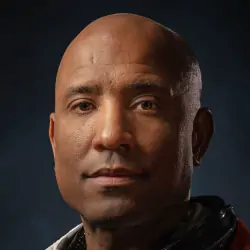

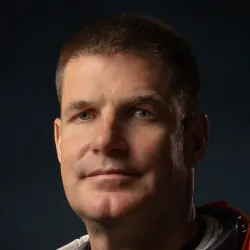
Wiseman

Yeah, let’s sync. Let’s sync real quick. Three, two, one—Integrity!
So we wear these [???] watches, and if you hit this button, the red light lights up, which tells you you got a good battery. And I don’t know why, but for the last two years when we wear these—hey Hopper!—for the last two years, when we wear these things, it just kind of brings us back into focus whatever we get a little distracted. So we did a lot of in-syncing when we were on this mission for no reason whatsoever.
I have absolutely no idea what to say! This is—24 hours ago, the Earth was that big out the window and we were doing Mach 39, and here we are back in Ellington at home. Every one of us are just going to give a couple words, but I get the mic first, so I’m going to start.
Victor, Christina, and Jeremy, we are bonded forever. And no one down here is ever going to know what the four of us just went through, and it was the most special thing that will ever happen in my life. And our families are over here, and with the exception of Dot, Suzie, and Jeannie, who are in the audience, but I don’t know where they are, but Dot, I’m going to hit McDonald’s later today in honor of your husband. No one knows what the families went through, man. This was not easy. Being 200,000-plus miles away from home. Like, before you launch, it feels like it’s the greatest dream on Earth. And when you’re out there, you just want to get back to your families and your friends. It’s a special thing to be a human, and it’s a special thing to be on planet Earth. Thank you.
The only person who can follow that up is Victor Glover, so let’s go!
Glover

And now we’re ready for questions. I’m going to keep it brief because I’m afraid to start talking. I have not processed what we just did, and I’m afraid to start even trying.
When this started on April 3rd, I wanted to thank God in public, and I want to thank God again. Because, even bigger than my challenge trying to describe what we went through, the gratitude of seeing what we saw, doing what we did, and being with who I was with, it’s too big to just be in one body. And I wanted to thank our families for everything that he just said. So: great words, great words, great words. I love you, but not just those five beautiful cocoa-skinned ladies right there—all of you. And I want to thank our leadership. And it’s changed since we were here in April of 2023, but the qualities haven’t. And we are fortunate to be in this agency at this time together. And so I’m going to sit down. Thank you also to our air operations for this facility, and for our ride home from San Diego. And I love you. Thank you.
Koch

Reid said it was a setup for us who had to follow him. That’s true. I couldn’t sleep this morning, so I did write some words down in my mind, and I’m going to try and share them with you today.
Ten days ago, this journey started with our mission manager, Sean Duval, knocking on my door in crew quarters and whispering, “Christina, we’re go for launch! Get up!” And it ended last night with my nurse on the ship put me to bed and said, “Ma’am, can I get a hug?” So a lot has happened since then between those two moments, but the start and the end were human moments here on Earth.
So, several years ago I was giving a speech, and I was doing my usual talk about crew and crewmates and teamwork, and someone asked the question, “What makes a crew? What is different about a crew than a team?” And I was like, “I got this!” Opened my mouth confidently to tell them everything I knew about being a crewmate. And everything that came out of my mouth was completely without value. I was like, “Yeah! Crews! They’re in space, and they work together, but they eat together too, so, you know, they’re a crew. And boats have crews. You know, you’re a crew if you’re on a boat. Helps if you have a paddle; that’ll be good, that’ll make you a crew. But the last 10 days I’ve gotten a little bit of a better answer on that question.
A crew is people—or, you know, a group—that is in it all the time, no matter what; that is stroking together every minute with the same purpose; that is willing to sacrifice silently for each other; that gives grace; that holds accountable. A crew has the same cares and the same needs. And a crew is inescapably, beautifully, dutifully linked.
So when we saw tiny Earth, people asked our crew what impressions we had. And honestly, what struck me wasn’t necessarily just Earth, it was all the blackness around it. Earth was just this lifeboat hanging undisturbingly in the universe. Uh-oh. So… I may have not learned—I know I haven’t learned—everything that this journey has yet to teach me. But there’s one new thing I know, and that is: planet Earth, you are a crew. Thank you.
Hansen

Well, it’s been a lot. This isn’t helping. But this is the furthest I’ve been away from Reid in a long time. Thank you. Alright, that’s good. Thank you. I think—yeah, thank you. I think what I’d like to share today is maybe three of the human experiences for us. And you haven’t heard us talk a lot about the science, the things we’ve learned, and that’s because they’re there, and they’re incredible. But it’s the human experience that is extraordinary for us, and it sounds like maybe for you, too. And so I think I’ll start with gratitude: gratitude for my family, gratitude for NASA, for its leadership, gratitude for Canadian Space Agency, gratitude pour les Canadiens, et j'ai hâte de pouvoir revenir, avec Reid, Christina, Victor. O Canada. Gratitude for the bravery and the courage for the teams to be no-go when we were no-go, and go when we were go. That took a lot. And I don’t think people will really ever fully comprehend how well supported and trained we were. It is almost unbelievable.
All right. And as my daughter would say, I’ll try and stay locked in here. Okay. The next one is joy. We have a term in our crew that we coined a long time ago: the joy train. And you saw, I think you saw—sounds like you saw a lot of joy up there. There was a lot of joy. We’re not always on the joy train, this crew. There are many times we’re not on the joy train. But we are committed to getting back on the joy train as soon as we can. And that is a useful life skill for any team trying to get something done.
And the last one is—I need your help for this. Come on up here, guys. The last one is love. What you saw was a group of people who loved contributing, having meaningful contribution, and extracting joy out of that. And what we’ve been hearing is that was something special for you to witness. And the reason I had them form up here with me is because I would suggest to you that when you look up here, you’re not looking at us. We are a mirror reflecting you. And if you like what you see, then just look a little deeper—this is you.
Wiseman
Dude, come on!