The Library of Consciousness

The Library
of Consciousness
of Consciousness
A Symbiotic View of Life
For animals, as well as plants, there have never been individuals. This new paradigm for biology asks new questions and seeks new relationships among the different living entities on Earth. We are all lichens.
Evolutionary Transitions
Heylighen summarizes the ideas behind metasystem transitions and introduces us to relevant published works on the topic.
Mind Outside Brain
We approach the problem of the extended mind from a radically non-dualist perspective. The separation between mind and matter is an artefact of the outdated mechanistic worldview, which leaves no room for mental phenomena such as agency, intentionality, or feeling. We propose to replace it by an action ontology, which conceives mind and matter as aspects of the same network of processes. By adopting the intentional stance, we interpret the catalysts of elementary reactions as agents exhibiting desires, intentions, and sensations. Autopoietic networks of reactions constitute more complex super-agents, which moreover exhibit memory, deliberation and sense-making. In the specific case of social networks, individual agents coordinate their actions via the propagation of challenges. The distributed cognition that emerges from this interaction cannot be situated in any individual brain. This non-dualist, holistic view extends and operationalises process metaphysics and Eastern philosophies. It is supported by both mindfulness experiences and mathematical models of action, self-organisation, and cognition.
The Computational Boundary of a “Self”
All epistemic agents physically consist of parts that must somehow comprise an integrated cognitive self. Biological individuals consist of subunits (organs, cells, and molecular networks) that are themselves complex and competent in their own native contexts. How do coherent biological Individuals result from the activity of smaller sub-agents?
The Global Superorganism
The organismic view of society is updated by incorporating concepts from cybernetics, evolutionary theory, and complex adaptive systems. Global society can be seen as an autopoietic network of self-producing components, and therefore as a living system or “superorganism”.
The Third Story of the Universe
Religion said “God did it.” Science said “physics did it—deal with it.” Neither told you why to get out of bed. The Third Story says the universe has been self-organizing toward consciousness since the Big Bang, and you’re a neuron in a waking planetary brain. Your purpose? More synergy, less friction. The cosmos is becoming. Join in.
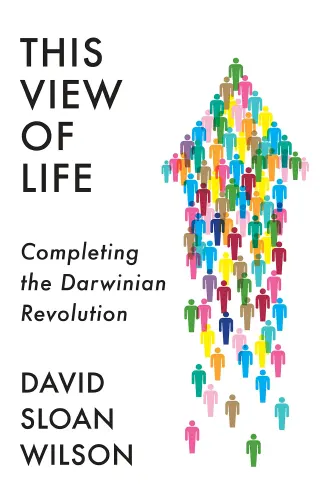
This View of Life
It is widely understood that Charles Darwin’s theory of evolution completely revolutionized the study of biology. Yet, according to David Sloan Wilson, the Darwinian revolution won’t be truly complete until it is applied more broadly—to everything associated with the words “human,” “culture,” and “policy.” In a series of engaging and insightful examples—from the breeding of hens to the timing of cataract surgeries to the organization of an automobile plant—Wilson shows how an evolutionary worldview provides a practical tool kit for understanding not only genetic evolution but also the fast-paced changes that are having an impact on our world and ourselves. What emerges is an incredibly empowering argument: If we can become wise managers of evolutionary processes, we can solve the problems of our age at all scales—from the efficacy of our groups to our well-being as individuals to our stewardship of the planet Earth.
What is the Noosphere?
Picture Earth evolving a new layer—not of rock or life, but of thought and technology. This “noosphere” is like a planetary brain emerging through our global networks, satellites, and collective intelligence. The paper explores how this mysterious transformation could represent Earth’s next evolutionary leap, potentially leading to planetary consciousness or even contact with other cosmic minds. It’s happening right now, though we’re still figuring out how to guide this planetary metamorphosis.