
Garan

When we see our planet from the perspective of space, certain things become undeniably clear. We keep trying to deal with issues such as global warming, deforestation, biodiversity loss as stand-alone issues, when in reality they’re just symptoms of the underlying root problem. And the problem is that we don’t see ourselves as planetary. When I looked out the window of the International Space Station, I saw the paparazzi-like flashes of lightning storms, I saw dancing curtains of auroras. It seemed so close it was as if we could reach out and touch them. And I saw the unbelievable thinness of our planet’s atmosphere. In that moment I was hit with the sobering realization that that paper-thin layer keeps every living thing on our planet alive. I saw an iridescent biosphere teeming with life. I didn’t see the economy. But since our human-made systems treat everything, including the very life-support systems of our planet, as the wholly-owned subsidiary of the global economy, it’s obvious from the vantage point of space that we’re living a lie. We need to move from thinking economy → society → planet to planet → society → economy. That’s when we’re going to continue our evolutionary process.
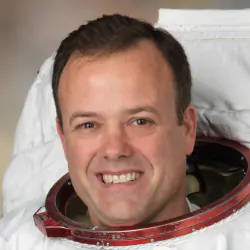
I’m Ron Garan. I’m a former NASA astronaut and former combat fighter pilot, and the author of Floating in Darkness: A Journey of Evolution.
We are all, as a species, to some extent, floating in darkness. And I use Plato’s allegory of the cave to illustrate how a lot of times we think we know the whole picture when, in reality, we see a very, very small representation. We don’t see the actual picture that will allow us to solve a lot of the problems that we face. And we’re paying a really high price right now as a civilization. This is a really, really dark time. And part of the reason why we’re not solving the problems is because we don’t have the right perspective. We’re not addressing things in the reality of the situation that they exist. And I think that’s one of the reasons why we need to leave the cave. We need to get out of the darkness.
A lot of astronauts who go to space come back and they feel that there has been some sort of transformation. And a term was coined back in the eighties called the Overview Effect. And the Overview Effect describes the shift that astronauts have when they see the planet hanging in the blackness of space. There’s this light bulb that pops up where they realize how interconnected and interdependent we all are. A little over fifty years ago, humanity as a whole had a collective out-of-body experience. On Christmas Eve, 1968, the crew of Apollo 8 came out from behind the far side of the moon on their fourth orbit. They took a famous color photograph and that photo is called Earthrise. Earthrise is the first color photograph to see the whole planet hanging in the blackness of space, and the first to capture that for the rest of us. And this image revolutionized how we see the world, how we see ourselves. There is no such thing as them, there’s only us.
And precisely one year before the Apollo 8 astronauts were hurtling through space on their journey to the moon, Dr. Martin Luther King Jr. gave a Christmas sermon on peace, and I believe that that sermon really gives words to what Earthrise evoked. Dr. King says, “As nations and individuals, we are interdependent. We’re not going to have peace on Earth until we recognize the basic fact of the interrelated structure of all reality.” Now the “interrelated structure of all reality”—that’s not a cliché, that’s not a philosophy, that’s the reality of the world that we live in. That’s fact: that what happens to one directly affects all of us indirectly; that we are all inextricably linked together in this fabric of life that we call Earth.
So if the overview effect is that light bulb that pops on, is the awareness of our interconnected, interdependent nature, the orbital perspective—which is the title of my first book—is what you do with that awareness. The orbital perspective is the call to action. It’s a sense of injustice that we see when we see the sobering contradiction between the indescribable beauty of our planet and the unfortunate realities of life on our planet for a significant number of the inhabitants.
One of the things that I realized during my time in space is that we’re not from Earth, we’re of Earth. And to take that one step further is that we’re not in the universe, we are the universe: we are the universe becoming conscious of itself.
A lot of what we’re talking about doesn’t require going to space to realize. You don’t have to be in orbit to have the orbital perspective. And one of the tools that we can use is a term that I borrowed from cinematography called a dolly zoom. And what a dolly zoom is, is where the camera is rolled back, or dollied back, at the same rate as the lens is zoomed in. And it was used in Jaws and Vertigo and many other films. And what the filmmakers use that technique for is to give altitude to a scene as the foreground stays the same and the background stretches. But we could also apply that term to the challenges that we face. If we dolly zoom a situation, that means that we zoom out to the widest geographical area we possibly can—ideally the entire planet. But as we zoom out to that big picture, we don’t lose focus on the worm’s eye details on the ground. We don’t zoom out to the point where people become numbers on a spreadsheet or a workforce or a voting block or a consumer block. They maintain their value as valued members of our human society. There’s also a temporal aspect to this. We need to zoom out to the longest time frame possible—ideally multi-generational. But in the process we can’t lose sight of the short term.
The last part of a dolly zoom is to see things from different perspectives. And so we understand the depth of our problem, and that makes our solutions that much more lasting and that much more effective. You have an incredibly powerful position to effect real change in the world. What I try and do is to live a constant dolly-zoomed life. I wake up every morning in my bed, but I also wake up on a planet.
In the long term I’m very optimistic, because I do see quite clearly a blossoming unity spreading across our planet, a blossoming awareness of our interdependent nature. That awareness will eventually reach critical mass, and when it reaches critical mass, then we’ll be able to solve the problems facing our planet. And it should give us courage during these dark times to keep doing what we know to be right, and to not give up hope—because we are going to see the dawn. And when we can evolve beyond a two-dimensional “us versus them” mindset and embrace the true multi-dimensional reality of the universe that we live in, that’s when we’re going to no longer be floating in darkness. We’re going to leave the cave. And it’s a future that we would all want to be a part of. That’s our true calling.