
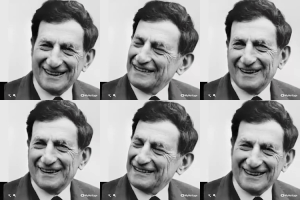
Bohm

Well, we’ve been discussing, then, this question of meaning, and the fact that it sort of is a vast field, most of which is not conscious, not even individual. It may not even be only at the level of human mind, it may be at the level of the whole body. It may even be at the level of the whole of nature. I mean, we could discuss that in more detail. I have some reasons which I can draw from physics in favor of that, but that would probably not here be the appropriate place for such a discussion.
Now, what we are conscious of is only sort of a little bit of this whole field of meaning. Meaning is active, it is actual. It disposes. And the disposition includes a disposition to generate new meanings, right? Like, if something means something of high value to you, you start to think about it and develop more meaning about it and so on. So the disposition also works back on the thought process to produce more meaning.
So you have the soma-significant, the signa-somatic, this cycle which is inseparable—to say it’s like north and south, it’s not two different things, right? And just two directions in the process. And different levels of subtlety saying, you see, a very elementary level of meaning might be in a reflex in the arm or the leg, and a more complex level going further back in the brain, and on and on to ever greater subtlety, and also including society and so on.
Now, the culture. You see, culture, in a way, it could be said to be a kind of shared meaning in society. See, that the cultural activity is basically not a function, you see, not a useful thing. If we did nothing but function, as I was saying, I think life would then become pretty dull and meaningless. See, people could say: where is the meaning of all this? You see, what’s the purpose of all this function?
But now, one of the meanings that people have—primary meanings that people may give—is culture, right? Saying the culture, which includes religion, science, art—art including all sorts of things, not just visual art, but music and literature, many other forms of art. So whatever gives meaning to life is part of the culture—at least what gives a shared meaning, right? And obviously there are cultures and subcultures and so on. And differences of culture are differences of meaning, which are very—when we get to supreme meanings, supreme values—then we find it very hard to bridge those differences without conflict.
So this question of meaning spreads out into everything. You see, people may say that this culture doesn’t mean very much to me. Life loses its meaning if culture degenerates. You have what they call the drug culture, which means that the drugs have a very great meaning. Not merely the effect of the drugs, but also the fact of sharing them. People feel that it means something to be with other people who can share the same life.
Now, a lot of this meaning has to do with thought. We said there might be a direct perception of meaning, which depends on a direct perception of the assumptions that are fixed, right? We discussed Newton last time, last night—that there are assumptions which are taken for granted without our being conscious. And the ability to perceive that assumption and be free of it is the essential step, and from there on it’s not so difficult to go on to a new meaning, right? But the principle of perception is the ability to perceive the function of the mind in holding to fixed meanings. What is it that holds you? You see, you can’t be conscious of it easily, because even that is concealed, right?
Audience

In the technical world, to hold a thought about anything requires some kind of status. Some stability, some holding.
Bohm
Yeah. We need the power to hold thought, you see? And then it’s overdone. We hold it absolutely, absolute necessity, right? Then that is where the trouble is. Now, we are not conscious of holding to thoughts with absolute necessity; very rarely. We are not conscious of what holds us. Something holds. There’s the urge to hold, right? But that urge to hold is not conscious. It is concealed, right? And even the fact that it’s concealed is concealed. Because if you didn’t conceal the concealment, then it would be no use concealing, right? So, therefore, it’s really very—at least in the face of it—it looks very difficult to see what can be done, right?
Now—and, you see, this is all misinformation, because the fact that we conceal things that are unpleasant to us or disturbing is misinformation, right? We have a disposition to conceal things that might disturb us, a disposition to deny that they’re there, you know, or even to deny that you’re denying it; to affirm something else, right?
Audience
But whether or not it’s concealed is still a fixed meaning.
Bohm
Yes, it works as a disposition. You see, the concealed disposition is just as effective as an unconcealed one in working, right? But we don’t notice this. You see, this is why it’s so dangerous. We don’t even know it’s there. If we had some intimation that it’s there, we tend to deny it, right?
Audience
What’s happening right now in this discussion? Is there an attempt to find out if this—I mean, is it happening that the concealment is revealing itself?
Bohm
Well, maybe a little bit, you see. I think we have to—this concealment is a very subtle process. I think we have to sort of go into it. I think that dialogue will play a big role in that, in uncovering this concealment.
Audience
The concealment itself—is that the outcome of a process?
Bohm
Yeah, the same process. You see, it’s very simple: that there are all sorts of things you should pay attention to and things that don’t require attention. See, if you didn’t put aside the things that don’t require attention, you couldn’t put your mind on the things that do, right? Now, therefore, you have that capacity, which is very necessary. But now, if you have an absolute necessity, you will put aside things which you should be paying attention to, right? There are all sorts of ways of putting things aside so that you don’t have to pay attention to them. Now, the point is that they are too rigid. They’re too powerful. There’s a disposition to put those things aside, to conceal them, to avoid them. Right?
Audience
It sounds a bit like being hypnotized.
Bohm
Well, that could be part of it. The hypnotism is the transmission of the meaning. And then you’re disposed according to the meaning of what the hypnotist has said, right? You see, it’s very simple, fundamentally.
Audience
It’s like being under a spell.
Bohm
Yeah. Well, a spell has a meaning, right? It’s something that the witch has said, right?
Audience
And that would no longer serve a useful function, being—
Bohm
No, but once the meaning is accepted, you’re under the spell. You see, you have to dispel the meaning.
Audience
The next step is attempting to say: well, how do you do that?
Bohm
Well, that’s what we’re exploring. We have to understand the subtlety of the thing, you see.
Audience
It’s almost as if we don’t. What I’m beginning to see here is that meaning is the thing that does the work. And yet, what we think is that we have to do something to either change the meaning or to get out of the fix that we’re in, in society and in our lives, and that there’s something that is doing action, that there’s something that’s doing effort. And yet, in a sense, it’s the very meaning itself that is doing the work.
Bohm
Yeah.
Audience
And so it almost implies that—forget about making an effort, and look to the meaning.
Bohm
Yeah, just if we can observe how meaning works. But see, when you say “look at the meaning,” because of our cultural conditioning, it tends to say “look at the content.” But not the process of meaning, right? The actual process. You see, “look at the meaning” means—if I say, “Look at the chair,” I could say, “Look at the actual chair.” I could say, “What is the chair?” It’s made of metal. It’s shining. It’s a certain shape. And so I could go into all that. But that would not be the same as actually looking at the chair, right? Now, you could form a visual imaginative picture of the chair from what I said. But, see, that’s different from looking at the chair. Now, we can describe various features of meaning and you could form some visual imaginative notion of what I mean, but then what I really mean is the process of meaning.
Audience
Well, actually, the change in structure outside the skin is changing the meaning, too. So that’s constantly moving. And so meaning is constantly moving in relationship to structure and the assumption about it. So it isn’t something that you can say is going to be permanent—as meaning, even.
Bohm
No, it’s not permanent. But at a certain moment, we look at it. You see, the chair has a relatively fixed form and structure. So if I look at the flowing stream, you see, or the clouds moving, at any moment, you see them as they flow and move. Now, meaning is like that.
Audience
Going back just a bit: could disposition function without concealment?
Bohm
Yeah, I should think it could. You see, not everything can be made conscious at once, because we can’t—if you were going to write, you can’t be looking at the same time all around you and so on. But if there is a resistance to seeing something, that’s where the danger is, right? If there is an attempt to defend a certain structure of meaning, right? Is that clear? Because it’s important to you as a human being, right? You see, if Germany means above all to you, then you will defend that meaning.
Audience
This is where the emotions come in, I think, like fear.
Bohm
Yeah. Well, naturally, if it’s threatened, then you will feel fear, right? If there’s something above all which is supremely precious, which is threatened, you must feel fear.
Audience
Yeah, which is there all the time, it seems.
Bohm
Yes. So you can see that those meanings, which have very high value, are very important to watch, right?
Audience
So then the implication is that there are really—there’s a system of meaning, or meaning is an order, a system that’s gradated. There’s a supreme meaning, and then there are subordinated meanings that have a certain relative meaning in relation to that supreme meaning.
Bohm
On the whole, yes. You see, except that we often may have contradictory supreme meanings. That’s one of our problems, right? That different people may have contradictory supreme meanings, or even the same person may have several contradictory supreme meanings. Like, you may say, “My country comes first, but really my life comes first.” That’s a very difficult conflict, right? You see, in the attempt to organize these meanings, you get into conflict because not merely contradiction in words, but the dispositions conflict with each other.
Audience
I still question that there can be a disposition without concealment. I don’t see that.
Bohm
Well, you see, suppose I’m disposed to walk in a certain way because I trust the floor to hold me. Or, as I drive a car, I’m disposed to expect a certain kind of traffic or a certain kind of road—you know, paved in a certain way, and so on. And then suddenly it’s all changed unexpectedly, and you change the disposition. I’m not concealing anything by being disposed to drive in a certain way according to what I expect the road to be. Right?
Audience
If you’re predisposed to have racial hatreds, you can admit it or flaunt it.
Bohm
What?
Audience
If you’re predisposed to have racial hatreds—some people would hide that, but many people don’t.
Bohm
Yeah, it goes both ways. I mean, some people will be ready to show them, and others will hide them, you see. But what you’re hiding really is the reasons why you’re predisposed, you see. In other words, you’re not really aware of why you are disposed that way instead of another way, and nor do you really want to be.
Audience
So then, once I become aware of that—my disposition—that no longer has power.
Bohm
If you are aware of its source, you see. But the disposition has its source in assumptions.
Audience
But now where does the disposition come that isn’t concealed, that has any power?
Bohm
A concealed disposition is one which you defend by false means, right? It’s concealed by some false thought, right?
Audience
Isn’t that disposition really invisible to me, the true disposition?
Bohm
It will be as long as it’s concealed.
Audience
If it becomes visible, it’s no longer a disposition.
Bohm
Why not? You see, there’s no resistance to it. You see, what I’m trying to say is, that if you’re disposed, let’s say, to sit on this chair because you’re tired and you believe the chair to be a good chair, and you find it’s actually very unstable, then you’re no longer disposed to sit on that chair, right? Because it no longer means a good chair to you. So the concealment means the resistance to being aware of the disposition when it is called for to be aware of it. You see, not that you can be aware of every disposition all the time, but at a certain moment when it is not fitting the reality, the normal function of the mind should be to be aware that I’m disposed wrongly.
Audience
Would you say that one could be disposed to step back from a precipice?
Bohm
Yes.
Audience
And that wouldn’t be concealed?
Bohm
No, you would see immediately you’re disposed, you see. But then, if you suddenly saw that it wasn’t a precipice or something, then it would change, right? Yes. You see, the important point is that the disposition has to be capable of becoming aware when it isn’t working, rather than—the concealment arises when you deny that the disposition is not working and give it another interpretation.
Audience
The difficulty is in the word “working,” then, because a lot of people think that their dispositions and assumptions are working perfectly.
Bohm
Yes. We have to say that they are deceiving themselves. You see, what I’m trying to say is that begin by noticing that self-deception is very pervasive in society. Now, you see, there are three words which are useful here: illusion, delusion, collusion. See, based on ludere—Latin, meaning “to play,” right? So illusion plays false with perception, delusion plays false with thought, and in collusion people play false together, either to deceive other people or to deceive themselves, right? And the point is that people often say, “Well, I can fool myself, but if everybody agrees, it must be right.” You see? But it doesn’t follow because of collusion, right? Everybody may collude to cover it up, right? To conceal. In many cases the individual may be more capable of seeing the concealment than the group. So a lot of the concealment is social cultural.
Audience
In a group, this collusion is a form of meaning.
Bohm
Yeah.
Audience
And that shows how the meaning sweeps us along, and how we’re—it goes back to that thought that the meaning sort of creates us. If we get in a group of people who have a certain feeling and a certain energy, we often become exactly the same way, not through any other reason than that we’re immersed in that feeling and energy. That’s how the meaning creates us, rather than we didn’t create the meaning.
Bohm
No, we are captured by the meaning of the group, you see. Now, that’s what happened with the Nuremberg rallies and so on—extreme case, right? A very powerful meaning there, and tremendous value. The other cases it may be less powerful.
So so we have this process of playing false, you see, which is—so, one of the properties of meaning is that there are certain meanings that may dispose us to play false. They could be individual or they could be in the group.
Audience
But if you have self-fulfilling assumptions, even though they’re false, how are you to be, if they’re self-fulfilling, how do you know that [???]?
Bohm
Yeah, I understand your question, yes. Well, we can gradually get into that. You see, you have a meaning—we are disposed to play false by certain meanings. I say, “My country above all” disposes me to play false. If I say, “My country is doing something wrong,” or “It’s being defeated,” or, “Things are going wrong,” so we have a censorship which covers all, conceals it all, and comes out with false affirmations saying, “We’re winning! Everything is wonderful! A glorious future lies ahead of us!” and so on, right?
So you can see it happening socially, but every individual does the same sort of thing, right? That the concealment consists of denying the actual fact and affirming something else, which sort of explains what is observed in a plausible way. It’s called rationalization. So we have this process of playing false, and we have certain kinds of assumptions which dispose us to play false, and to conceal the fact that we are doing all this.
Now, this is very hard to get out of. We are going to have to have a very intense interest in this to be able to do anything. But you have this process now. See, I think I’m just calling attention to another structure of the difficulty: that every one of these assumptions which causes trouble is one of absolute necessity. It creates an unyielding disposition to play false, right?
Bohm
Now, see, so if we see something isn’t working, as we say, if we could see it, we would give it up, right? But we don’t want to see it really. But there are two stages in this. One is to say the assumption itself, the thing itself, is necessary, right? And the other is to say that the thought about it is necessary, the assumption; you see, that we not only have, say, the necessity of my country above all, but that assumption itself is held to be necessary in the sense that I cannot entertain any other idea to play with it, right? So playing false consists of a lack of free play among the possibilities. Is that clear? Saying I cannot even entertain the notion that maybe my country is not above all, you see?
Now, see, if I have an assumption of very high degree of necessity—which I can hold—but my mind is still free to entertain the notion that maybe it is not so necessary, I can explore mentally. Is that clear? But these assumptions have the character that the necessity is itself absolutely necessary. Right?
Audience
I think it’s important to look into the meaning of what necessity means in relationship to the assumptions. Because necessity [???] is, in that context, is a means to be secure, to be permanent. And it’s taking the assumptions as a reality which is permanency and upon which permanency is based on. And so that is what means when something is, let’s say, working for an individual, it has a measurement attached to it, a causing-and-effect of that individual being secure because that individual is those assumptions.
Bohm
Yeah, well, that’s true; that all this is part of your being, and that this absolute necessity—whatever you take to be absolute necessity becomes your being, right? And you don’t take it for yourself, it comes from your society. You see, you pick it up. It’s your idiosyncrasy.
Audience
But it is the individual really can’t be—let’s say the society isn’t causing an effect on the individual. There is, in other words, no blame to put on a—but the individual himself or herself is that—
Bohm
Yeah, you are that, you see.
Audience
[???] from just simply accepts it from [???]
Bohm
Yes, that’s right. You have become just that. And, you see, it’s like the virus again. You see, you are exposed to virus particles, and you start to multiply viruses in yourself. At a certain stage, you could say you are the viruses, you see. That’s just part of your being, right? It’s not to say that the virus is something different. You could say the virus—they called it Asian flu; you see, there’s nothing Asian about it. You see, it’s your own flu. You have provided the—your body has carefully nourished all these virus particles and multiplied them, right?
So therefore, if somebody says something—say, “My country above all”—that is like a virus which enters everybody. And unless you have the immune system working, it will spread, right? So when you have got the disease, it’s your disease. Of course, its origin, it’s also the disease of the whole society, right? So that’s to say it’s no use blaming anybody for this or to attribute it to some particular source. You have to say the real problem is this meaning process which has become wrong, right? The process of meaning has gone wrong. Now—and some, you know, that has to change. Whether individually or together, there has to be a change, you see.
Audience
Would you say that pragmatism is also a virus?
Bohm
Yes. I mean, you could say pragmatism, carried to an extreme, it’s a virus. Up to a point it’s useful, but make it an absolute necessity—you see, you could say cancer has this quality of absolute necessity of growth. You see, it doesn’t yield to the needs of the body, right? So the virus does the same. So therefore, there’s a structural similarity of the way these things work. There are meanings at different levels. And, you see, in other words, the way the cancer cell’s DNA has gone, it means: don’t yield and just keep on growing. But normally, the body must somehow send signals to the cells to say: stop growing at this point. You know: fit in with the rest of the body. Now, you see, any individual could then function like a cancer, or a whole group could; say, “Our goal must take precedence above all.” And therefore it will never yield, right? Nothing can make it fit, right? And then you have this self-deception, this falseness, going on.
I think I would like to make one more word here: the distinction of false and true, as compared to the distinction of correct and incorrect. Now, you see, if we say an idea is correct, okay, it fits the fact up to a point. If it’s incorrect, it doesn’t. That’s roughly the idea. But now, false and true are often used as the same as correct and incorrect, but in a way that is confused. You see, the word “false” is based on a root meaning deceptive. Now, “incorrect” is not necessarily deceptive, it’s just a mistake. You’re ready to correct it. So normally, many of your ideas are bound to be incorrect. You don’t have perfect knowledge, you see. But “false” means the ultimate aim is to deceive. The disposition is to deceive, right?
Now, “true” means “straight” in English. A true line is a straight line. And to be true to something, you see, that’s a similar notion, true to your principles. So we could say in Latin, the word verus means “true.” It means that which is. The English “was” and “were” have the same root, and the German war.
So if you put the two meanings together, you could say truth is to be honest and faithful to that which is. Therefore, truth is not merely in the content, but it is in the whole activity. The same with falseness. Whereas correctness and incorrectness is only a comparison of content with fact.
Audience
That’s because the activity is a process.
Bohm
Yeah.
Audience
And it’s moving.
Bohm
Yeah. And that’s also all one, right? It’s a cycle. It’s a circulation. So we could say that a statement may be correct but untrue. And to say a statement which is at least ostensibly correct may be part of the concealment of something else, right?
Audience
A question that’s very important is we’re always alert to what’s going on, because meaning is changing so often. And unfortunately, I don’t think we don’t bother to be alert to what’s going on.
Bohm
Well, that’s part of it. But I think we are disposed not to be alert. You see, certain meanings will put us to sleep. Yeah, you see, other meanings may help us to wake up. If somebody shouted “Fire!” it would mean: wake up!
Audience
It seems to me that we’re necessarily disposed to conceal and to be false, and that we could not be disposed to not conceal and to be true.
Bohm
Well, it may be, but that would be a fixed disposition. But we may be disposed toward a correct idea. We don’t have to be disposed to something incorrect. We may be disposed to an action which in this context is correct.
Now, truth and falseness must be something deeper. You see, to be true is to be straight, honest, and faithful to that which is. And false is to be twisted, you know, not to be that way; to be aiming at concealment, to be disposed to conceal, to deny what is actual, and to affirm what is not actual.
Audience
Which seems necessarily the way we must be.
Bohm
Well, we have an absolute necessity behind it. If it weren’t so, we would stop it, you see. You see, the minute you see something is false, the urge to do it is gone, right? But the trouble is that we have a disposition not to see that.
Audience
So we could have a disposition, perhaps, not to be true, but to see what was there.
Bohm
Well, I don’t know if we would call it a disposition, but we could say that truth would be the natural right mode of work of the mind, right? And falseness is some sort of disease, like the virus or the cancer which has taken over, right?
Audience
But it certainly isn’t for me to choose to be true.
Bohm
No, no, quite correct, as well as true.
Audience
But have we discovered why this is happening?
Bohm
No, we haven’t. I’m trying to outline what the problem is, you see. I mean, in other words, that’s what I said I would present something, which I call the problem, you see. So—
Audience
Is it possible to discover why?
Bohm
Well, we’d have to see it. If I say, “Is it possible to see this chair and not just talk about it?” you see. Suppose you had never seen a chair, or whatever it is, and we could describe it, and talk about it, learn something of its structure, and all of that has some value. But then we say: meaning must be seen as an actual fact, right?
Audience
It seems to be quite a split. In technology, we’re willing to make any change at any time and give up the old. But psychologically, we’re not willing to do that, even though it’s the same process. When something new comes along, I mean, we’ve all got TVs and VCRs, and twenty years ago there wasn’t one—there was no problem with that. When they wiped out smallpox or whatever it was on the planet, we didn’t have any emotional problem with that. But all these ideas, these concepts that don’t have any—they seem to have much greater hold on us.
Bohm
Well, because they have to do with ourselves. You see, you brought up the word “concept.” This is a crucial part of the structure of meaning, of thought. You see, I said that there would be the possibility of seeing meaning which was not dominated by the past. We said the usual way of seeing meaning is dominated by what is already known. We are predisposed to see it that way.
Now, we have to go into this question of concept. I don’t know whether we have time. Do you think—
Audience
Depends on whether you want to [???]
Bohm
Yes. Yeah?
Audience
In light of what he said and you were just saying: wouldn’t it be, as was said, that the mind is lazy and we take the path of least resistance? We have a memory or a track already ingrained and we tend to follow that because it’s the easiest way through. We don’t want to fight for the truth. We want to go where we’ve gone before.
Bohm
That’s so, but I’m suggesting that we have been predisposed to that by certain meanings. See, in other words, if we said that’s the way we are, then what could we do, right? I mean, that’s the way we are and that’s all there is to it. But if we say that there actually is a deeper source or cause of that, that we have become predisposed—you see, if you take a young child and say it’s full of energy, it’s always exploring, doing this and that, but as it grows up, it gets all sorts of predispositions, it becomes worried about things and lazy about other things because perhaps it’s had bad experiences. So, you see, we have to be careful not to accept assumptions tacitly in the form of something that’s always so, right? Because if it’s always so, it is immediately implied that it is absolutely necessary. So, you see, what is always so, what is altogether so, or what is all that way is absolutely necessary.
Audience
It’s like one of the assumptions that I noticed is you made the statement that I hear a lot that people take this course because it’s easy. And yet, if you look at it clearly, you can see that they expend all of their life energy maintaining this illusion, maintaining these assumptions, when the easy way would be to let them go—if you talk about easiness being energy. And yet a lot of people say: well, we’re this way because it’s easy. But there’s nothing easy about giving your life up for all this insanity.
Bohm
Yes.
Audience
[???] make such a dogmatic [???]
Bohm
Yeah, well, yes. You see, it’s like saying the whole thing is really pretty crazy, right?
Audience
I would say that. One of the crazy things is saying that we do it because it’s easy.
Bohm
Yeah.
Audience
Not saying anything about, you know, what it seems I hear so much.
Bohm
Well, we hear it all over. You see that saying that people do whatever is easy. But, you see, it would be right to do what was easy if it were really easy.
Audience
Well, I think, if I observe myself, I used to do it because I didn’t want to be isolated from my friends. So that was easier to do that than face the fear of being alone and having to structure my life around myself and understand it. I didn’t have to give up myself and I’m so afraid of isolation.
Bohm
Yes. Well, it’s still the same question, you see, because it’s a set of assumptions, you see, that it would be easier to engage in collusion than not, right? Now, it actually isn’t, because, you know, if you follow it through, you see that what is implied in that is all sorts of things that are very difficult. I mean, all sorts of problems. Do you see what I mean?
So therefore, why do we hold onto this? See, we don’t notice that all these assumptions are not working out. In technology, perhaps we would, right? In a similar case. I mean, if our own personal interests were not at stake, then we would notice that this thing is not working the way it’s supposed to work, and therefore we try to change it. But see, here we have a concealment going on. We don’t want to notice that the assumptions are not true. They’re both incorrect and untrue, right?
Audience
But isn’t that one of the difficulties in this concealment—which, as you stated before, is something that we really do not know, that is unknown to us? So for me, the difficulty then seems to be: how can I know something, or un-conceal something, manifest something, that is really conceived from me; that I don’t even know that it is concealed? How can I find out about this? How can I approach this?
Bohm
Yeah, well, let’s talk about it for a while. Somebody else wants to say something.
Audience
Concealment would no longer be a concealment if you had a violent argument with someone or a very traumatic experience when, possibly, after learning this, you would have introspection and see this truth that the easier pattern kept you from seeing. But it takes a violent, wrenching, terrific thing happening to you for self-analysis, usually—to really look inside.
Bohm
It may, you see. But then that’s an assumption that it always takes. Right? Necessarily. You see, you have to be careful that—see, I think this is an interesting point right here, you see. Watch how we’re going. We can see how the concealment takes place. It’s not such a mystery as it looks, right?
You see, suppose we say: in our society, in our subculture, we are in the habit of saying that this—without actually using the word always—to imply that this statement is always the case. Now, that immediately produces the force of absolute necessity.
Audience
[???]
Bohm
Yeah. And therefore, the mind doesn’t want to yield on that and saying maybe it could be otherwise. Right? So therefore, the whole thing has not been terribly mysterious. You see, it’s fairly near the surface, a lot of this concealment.
Audience
Don’t we have to bring in the question of energy? In order to conceal, it must take energy. The act of concealment—have to constantly be investing your energy in maintaining these assumptions. And that energy isn’t—when the assumption’s gone, the energy’s freed up. And so we take all our energy and put it into these things, and we don’t have enough energy left over. I don’t know.
Audience
Most of us alive are doing that.
Audience
So you say we take, but actually we don’t. It takes place. It takes us.
Bohm
It’s important to—yes, to notice that.
Audience
So you say all this is near the surface, and what is true is deep. Is that what is…?
Bohm
Well, that’s part of it, yes. I mean—but at least the concealment may be near the surface, but often rather hard to get hold of because of the violent energy in that concealment, right?
Audience
There’s also the notion here that we can’t get hold of the concealment, and that may be erroneous.
Bohm
It may be, but if we assume it to be that we can’t get hold of it, then that will be a self-fulfilling assumption.
Audience
No, but what I mean is: the same movement which conceals wants to take hold. And that’s what I mean.
Bohm
Yeah. Oh, yeah, yeah. I don’t mean—the word take hold again. We have to be careful. It doesn’t mean that we were going to take hold. We are going to, we hope, see the falseness of this process, right? So that it will die.
Audience
That’s the problem in speaking of this, because then I have the notion that I will see this process, which is the same as the taking home.
Bohm
Yes, we have all this problem of language which creates—we’ll have to discuss that—it creates a distinction between the observer and the observed, and brings in time in a false way, and so on. You see, I think we’ll discuss this the next time, you see, but let’s just say I’m glad all this came up, that the—there’s a rather complex process that has to be disentangled, you see, if we’re going to talk about it.
So the point is that our ordinary language has evolved in such a way it deals with certain technical problems by separating the observer from the observed—which is all right up to a point. But it extends that into other areas where this separation is not valid, you see. Even technically, it’s not always valid. And so that is part of what’s going on: that this language is conditioning us, disposing us, to act in certain ways, to think in certain ways. And we don’t notice that it’s so because everybody’s doing it, right? So therefore, the assumption may be that if everybody’s doing it, it must be all right. But, in fact, without noticing it, we get involved in a kind of collusion.
Audience
[???]
Bohm
Well, for example, in discussing the quantum theory in physics, there’s a lot of evidence which suggests that at least the observing instrument cannot be separated from the thing observed. So there’s an analogy. The attempt to analyze this process is failing in that way.
Audience
[???]
Bohm
Well, as far as physics is concerned, in the present situation, it’s assumed that the connection between the human being and the instrument is not important. He is connected, but it can be regarded as not important. Now, therefore, physics doesn’t go as far as we have to go when we discuss the mind, right? At least not at present.
Audience
The person who uses the instrument is [???]
Bohm
He can treat himself as quite different from the instrument, you see. Now, the instrument is not that sensitive that it responds to his mental state, you see. If it were, then he would have to watch out, right? You see, suppose someday people make instruments—as they think they’re going to do—to connect wires up to the skull so that thoughts will be able to affect the computer or the machine, right? So the machine can respond to your very thought. Then you couldn’t separate yourself. But the present machines don’t do that.
Audience
Not so obviously.
Bohm
Not so obviously. But in a certain sense, there’s a separation. I can think about the machine, the machine goes on functioning no matter how I think about it. It will affect what I do to the machine or affect how I interpret the results of the machine.
Audience
It seems like there has to be a value in [???] I’m wondering if it’s trying to look at that and trying to discover that value would not be useful.
Bohm
Well, see, up to a point, to just put things aside and not to pay close attention to them is necessary, right? I mean, when you’re doing something, you can’t be looking at everything else, right? Hmm? But this is carried too far, because evidence comes up that you should be paying attention to something else and you don’t, right?
Audience
I was thinking of the value in doing that.
Bohm
Well, I don’t know if it has any value. You may think it has value. You see, the mind may be assuming that it has value.
Audience
To conceal something is too high for me, or to put something under the carpet so it’s not there. When one looks at a form, it’s security, it’s looking for that security. Because when the enemy is out of sight, so to speak, the bad thing, separate from the good thing, the bad thing isn’t there, and so to conceal it is to maintain that sense of security, so the bad thing won’t attack it. In actuality, because the mind has created that, the creation of that, that bad thing is there.
Bohm
But it doesn’t make sense because it’s still there. You see, in other words, it’s true, people do do this. You see, there was this cartoon many years ago in The New Yorker of two ladies walking along the street and a big tiger was behind them. And they said, “Perhaps if we don’t look, it’ll go away.” But you see, it doesn’t make sense.
You see, why do we proceed with an operation that does not make sense? It doesn’t produce security. It produces more insecurity. But only because we are disposed to think that it does. We are disposed to think falsely that it is producing security when in fact it is not, you see.
Well, generally speaking, people feel that not only we have to make sense, but it’s dangerous to proceed with nonsense, right?
Audience
It doesn’t make sense to begin with, which isn’t obvious.
Bohm
Yeah, the whole society is based on a lot of nonsense, but we simply don’t conceal it, right? Like the tiger. But this tiger is going to catch up with us someday.
Audience
We spend a lot of energy in propaganda and advertising, and the main institutions of education are to keep all this illusion going.
Bohm
Yeah. Yes, you see, illusion is just false meaning. It is not total unreality, right? You see, if you take a mirage in the desert, the air bends the light from the sky up as if it were coming from the ground. Now, that’s the right meaning, but if it means water to you, that’s a false meaning, right? If you go there, you will get nothing to drink, right? So, therefore, the point is that you may, in that case, you say, well, if a person didn’t know that mechanism, it’s quite understandable that he would make that mistake. But if he said, “Anyway, I know that mechanism, but I still believe it’s water because it’s nicer to believe it’s water,” then that will kill him because he’ll just wander that way and he’ll get exhausted.
Okay.