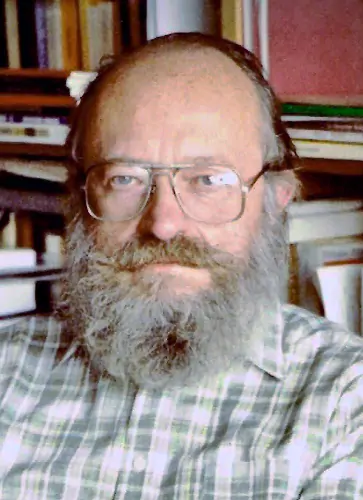
Portrait of Leo Apostel

Leo Apostel

Philosopher and Professor
September 4, 1925 – August 10, 1995

Leo Apostel was a Belgian philosopher, logician, and interdisciplinary thinker best known for his efforts to connect knowledge across different fields. Rather than focusing on a single branch of philosophy, Apostel believed that science, philosophy, religion, and everyday human experience should be understood as parts of a larger whole. Throughout his career, he worked on questions about how people construct worldviews—the broad frameworks through which they make sense of reality, society, and their place in the universe. His work drew on ideas from mathematics, systems theory, psychology, and the natural sciences, reflecting his conviction that many of humanity’s most important questions cannot be answered within the boundaries of a single discipline.

Apostel became particularly influential for his research on worldview construction and his advocacy of a unified, systems-based approach to knowledge. He argued that every person and culture operates with an implicit worldview, whether consciously recognized or not, and that examining these frameworks can help people better understand both themselves and others. At a time when academic fields were becoming increasingly specialized, Apostel championed intellectual synthesis, seeking connections between seemingly unrelated domains of thought. His work continues to attract interest among philosophers, systems theorists, and scholars interested in interdisciplinary approaches to understanding complex problems.

WIKIPEDIA ➦

1 Document

Filter

Sort

Alphabetic

Date

Duration

Word Count

Popularity

Mentioned in 3 documents

Francis Heylighen and David Sloan Wilson

Glimpsing the Global Brain

Complex systems theorist Heylighen and evolutionary biologist Wilson discuss a possible phase transition of humanity in which the members of our species become neurons in a planetary brain, utilizing the Internet as a shared exocortex.

Francis Heylighen

The Global Brain as a New Utopia

The global brain can be conceived most fundamentally as a higher level of evolution, the way humans form a higher level of organization that evolved out of the animals. Although the analogy between an organism and a society can be applied even to primitive societies, it becomes clearly more applicable as technology develops. As transport and communication become more efficient, different parts of global society become more interdependent. At the same time, the variety of ideas, specializations, and subcultures increases. This simultaneous integration and differentiation creates an increasingly coherent system, functioning at a much higher level of complexity.

Francis Heylighen, Shima Beigi and Clément Vidal

The Third Story of the Universe

Religion said “God did it.” Science said “physics did it—deal with it.” Neither told you why to get out of bed. The Third Story says the universe has been self-organizing toward consciousness since the Big Bang, and you’re a neuron in a waking planetary brain. Your purpose? More synergy, less friction. The cosmos is becoming. Join in.